⏩ stepit 'baseline': Starting execution of `strom.modelling.assess_model()` 2026-04-12 13:37:22

⏩ stepit 'get_single_split_metrics': Starting execution of `strom.modelling.get_single_split_metrics()` 2026-04-12 13:37:22

✅ stepit 'get_single_split_metrics': Successfully completed and cached [exec time 0.0 seconds, cache time 0.0 seconds, size 1.0 KB] `strom.modelling.get_single_split_metrics()` 2026-04-12 13:37:22

⏩ stepit 'cross_validate_pipe': Starting execution of `strom.modelling.cross_validate_pipe()` 2026-04-12 13:37:22

[Parallel(n_jobs=-1)]: Using backend LokyBackend with 4 concurrent workers.

[Parallel(n_jobs=-1)]: Done   5 out of   5 | elapsed:    2.1s finished

✅ stepit 'cross_validate_pipe': Successfully completed and cached [exec time 2.1 seconds, cache time 0.0 seconds, size 2.2 KB] `strom.modelling.cross_validate_pipe()` 2026-04-12 13:37:24

✅ stepit 'baseline': Successfully completed and cached [exec time 2.2 seconds, cache time 0.0 seconds, size 16.0 KB] `strom.modelling.assess_model()` 2026-04-12 13:37:24
Baseline Model
From the first look at the correlations, a model with polynomials looked fitting. So let’s here fit such a model, that would be the model to beat later down the line.
Polynomial Model
Here we stick to a simple OLS, but using a polynomial specification for the predictors temperature and air humidity, thereby, addressing one of the TODOs listed after the naive model
Metrics
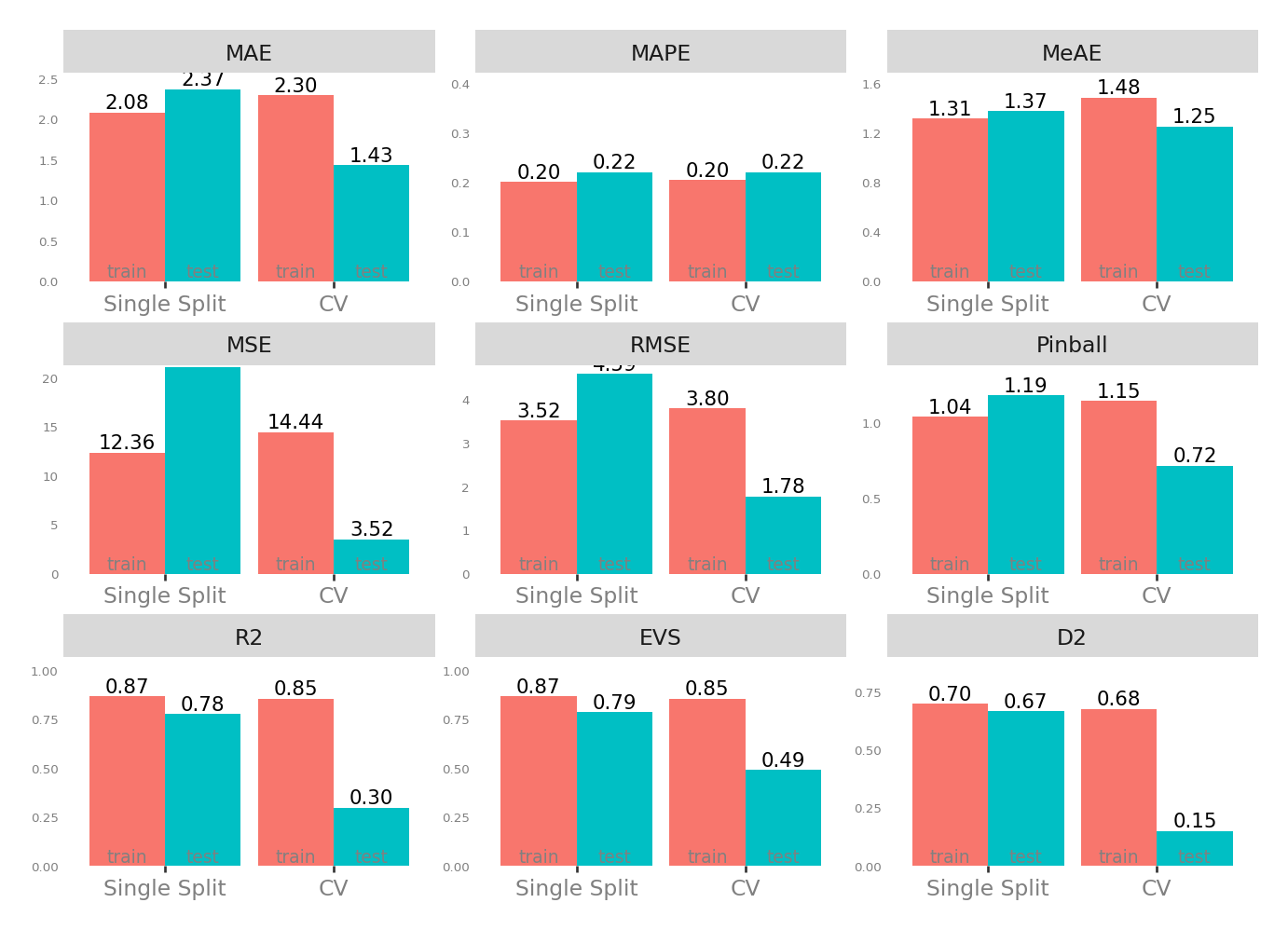
| Single Split | CV | |||
|---|---|---|---|---|
| train | test | test | train | |
| MAE - Mean Absolute Error | 2.081643 | 2.474265 | 1.434205 | 2.296273 |
| MSE - Mean Squared Error | 12.356684 | 19.408106 | 3.516287 | 14.429139 |
| RMSE - Root Mean Squared Error | 3.515208 | 4.405463 | 1.776508 | 3.796345 |
| R2 - Coefficient of Determination | 0.867416 | 0.801708 | 0.296421 | 0.854208 |
| MAPE - Mean Absolute Percentage Error | 0.200508 | 0.202882 | 0.220062 | 0.204431 |
| EVS - Explained Variance Score | 0.867416 | 0.802337 | 0.490443 | 0.854208 |
| MeAE - Median Absolute Error | 1.314457 | 1.477188 | 1.249098 | 1.484622 |
| D2 - D2 Absolute Error Score | 0.699481 | 0.677488 | 0.149788 | 0.676571 |
| Pinball - Mean Pinball Loss | 1.040821 | 1.237133 | 0.717103 | 1.148137 |
Scatter plot matrix
Observed vs. Predicted and Residuals vs. Predicted
Check for …
check the residuals to assess the goodness of fit.
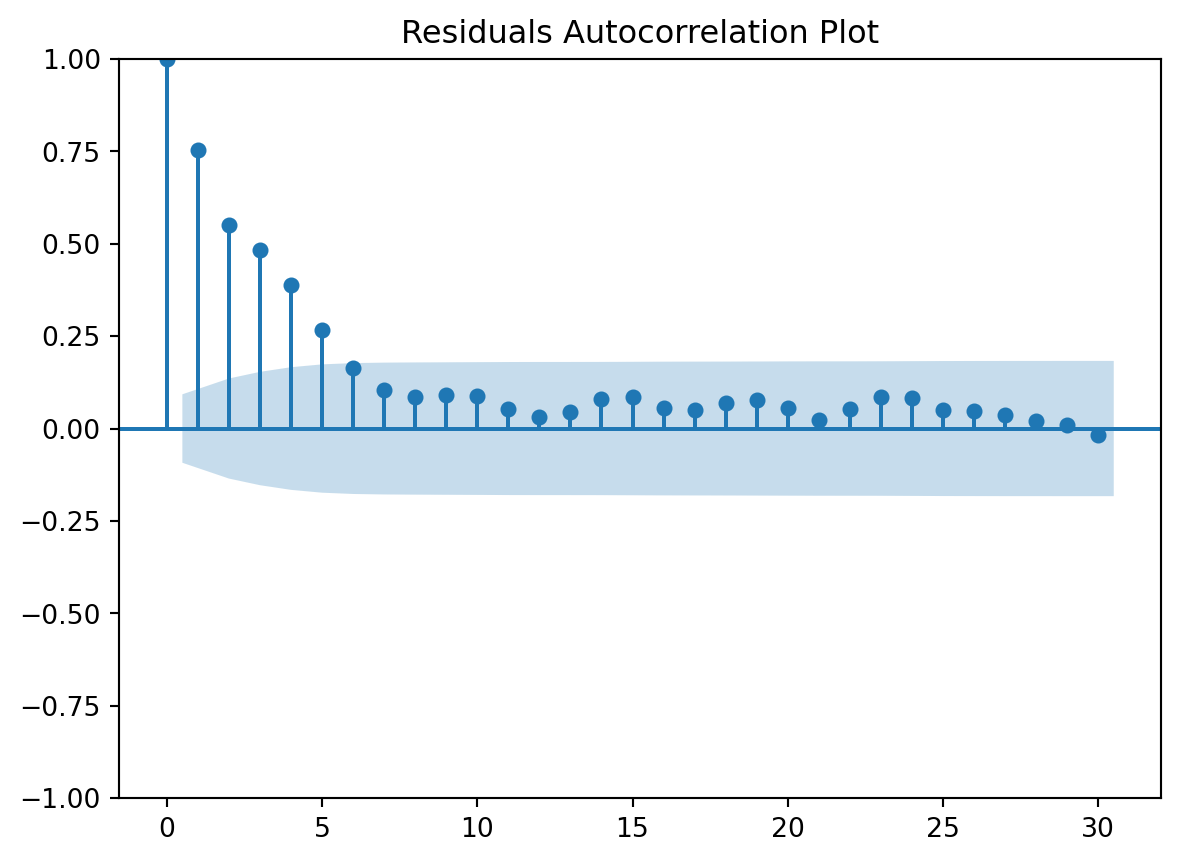
- white noise or is there a pattern?
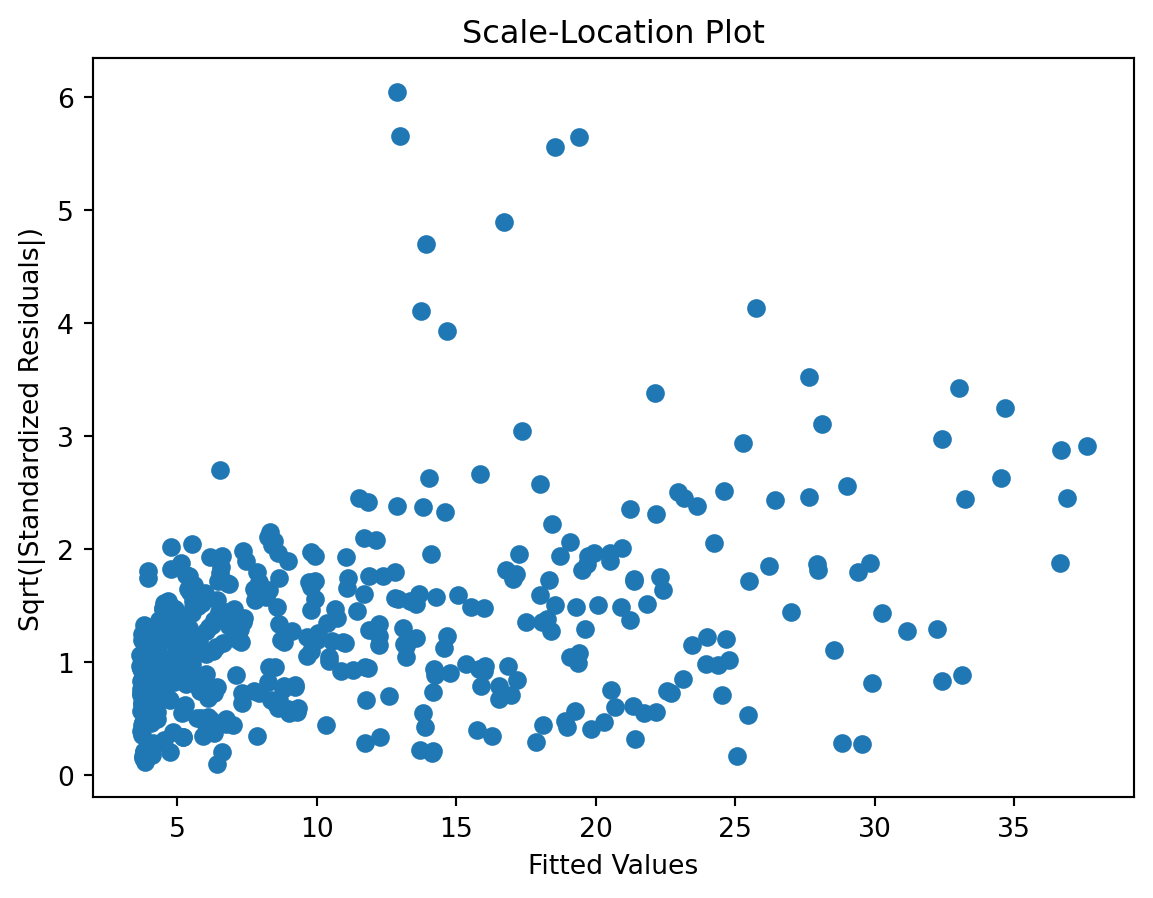
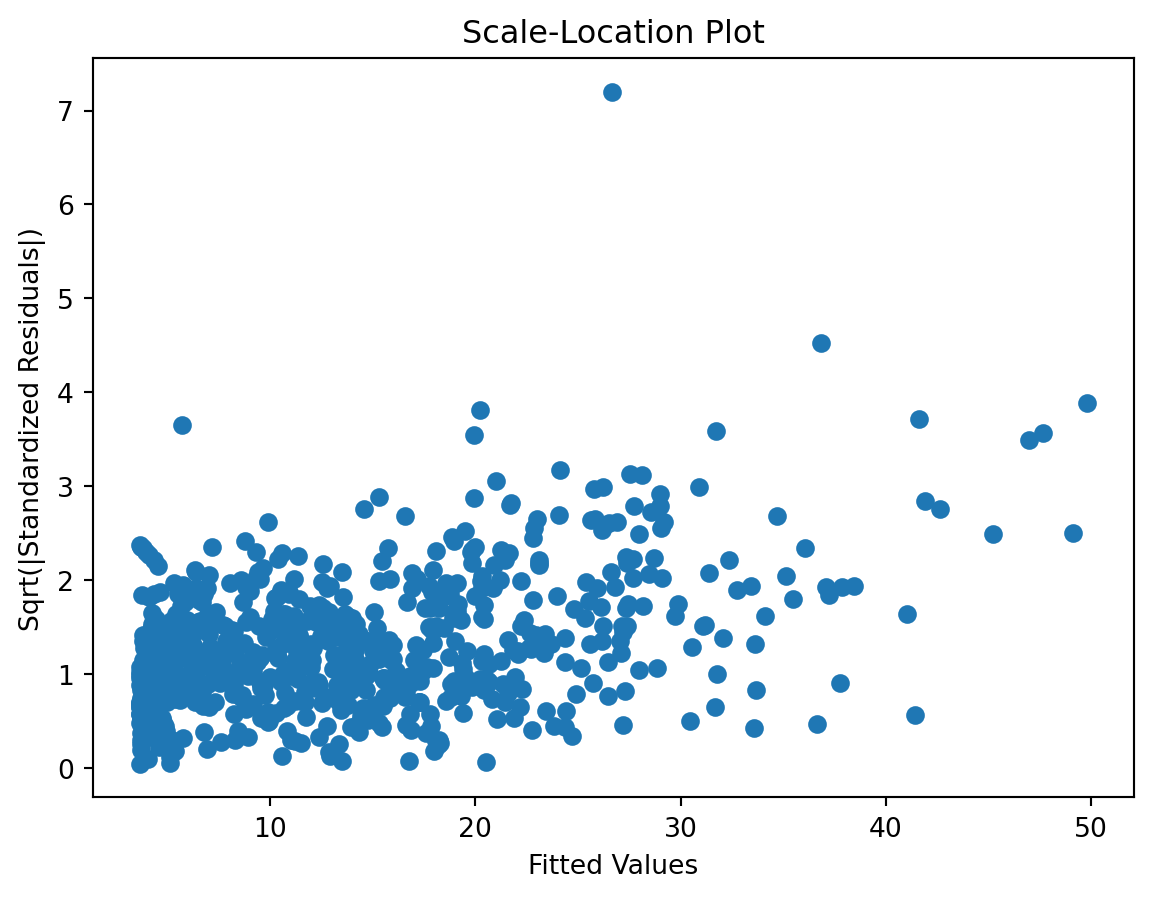
- heteroscedasticity?
- non-linearity?
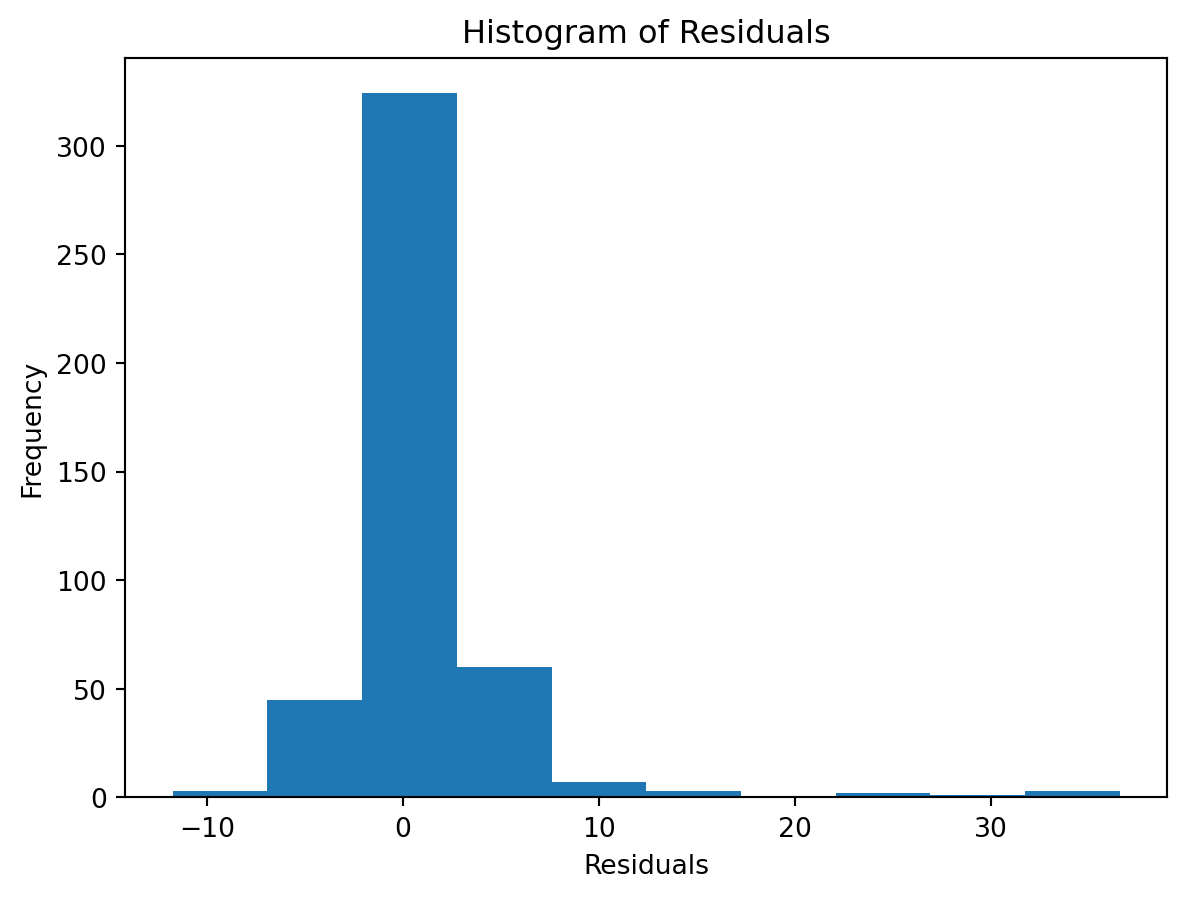
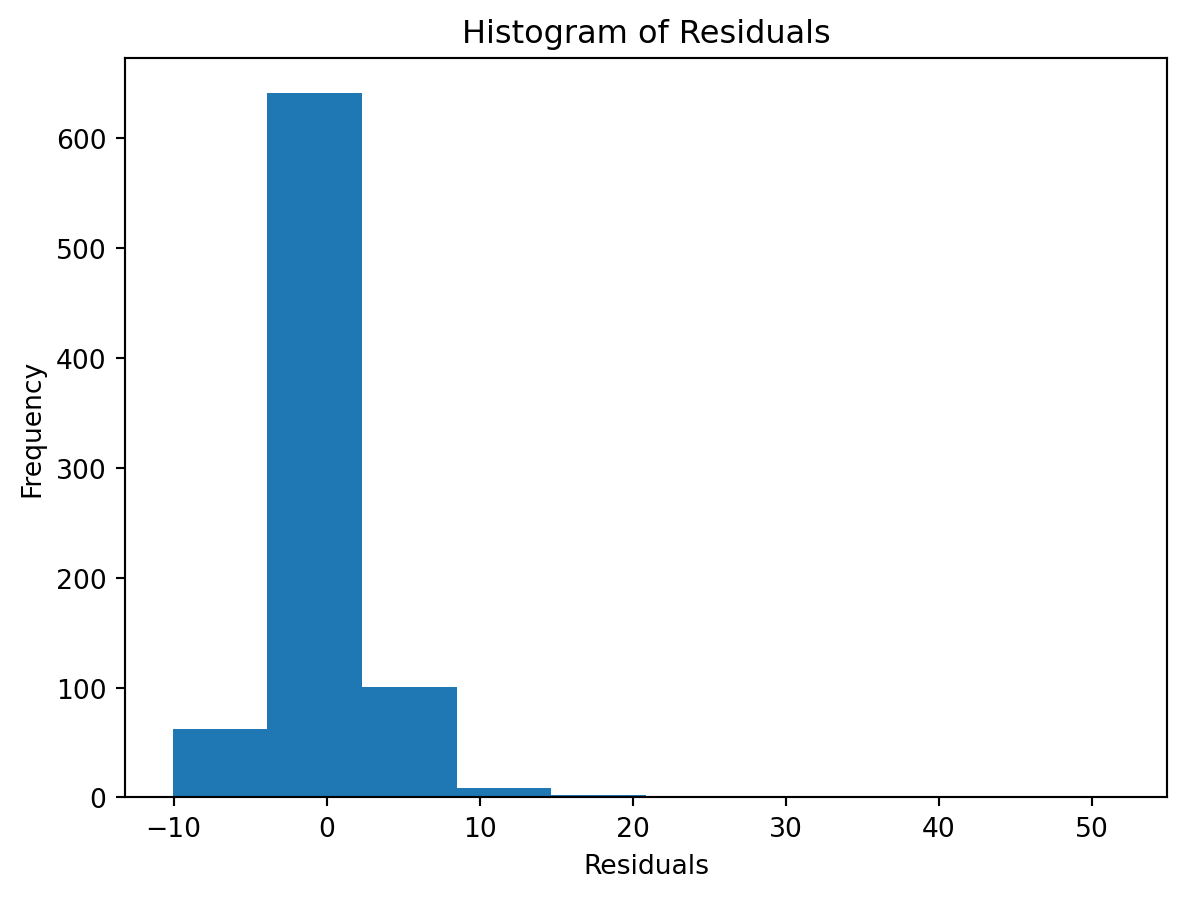
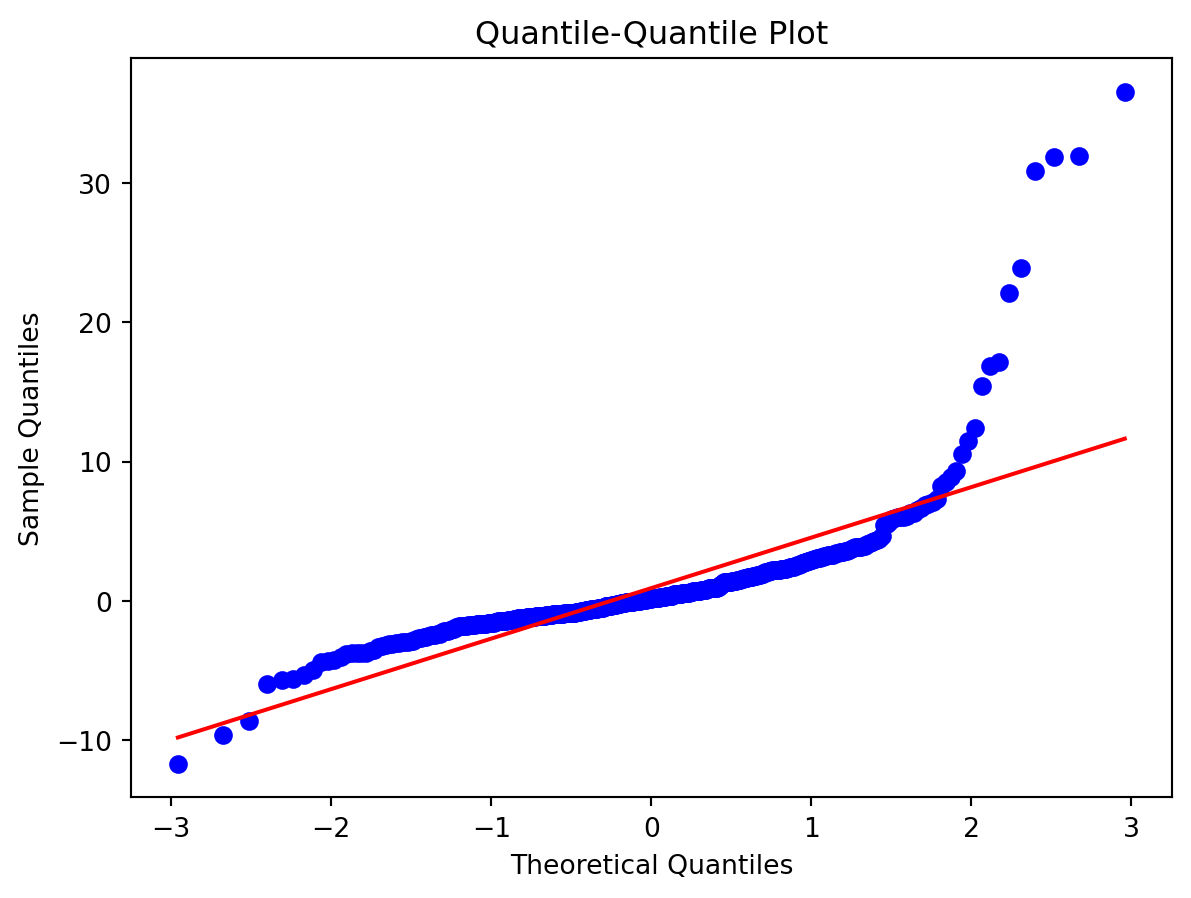
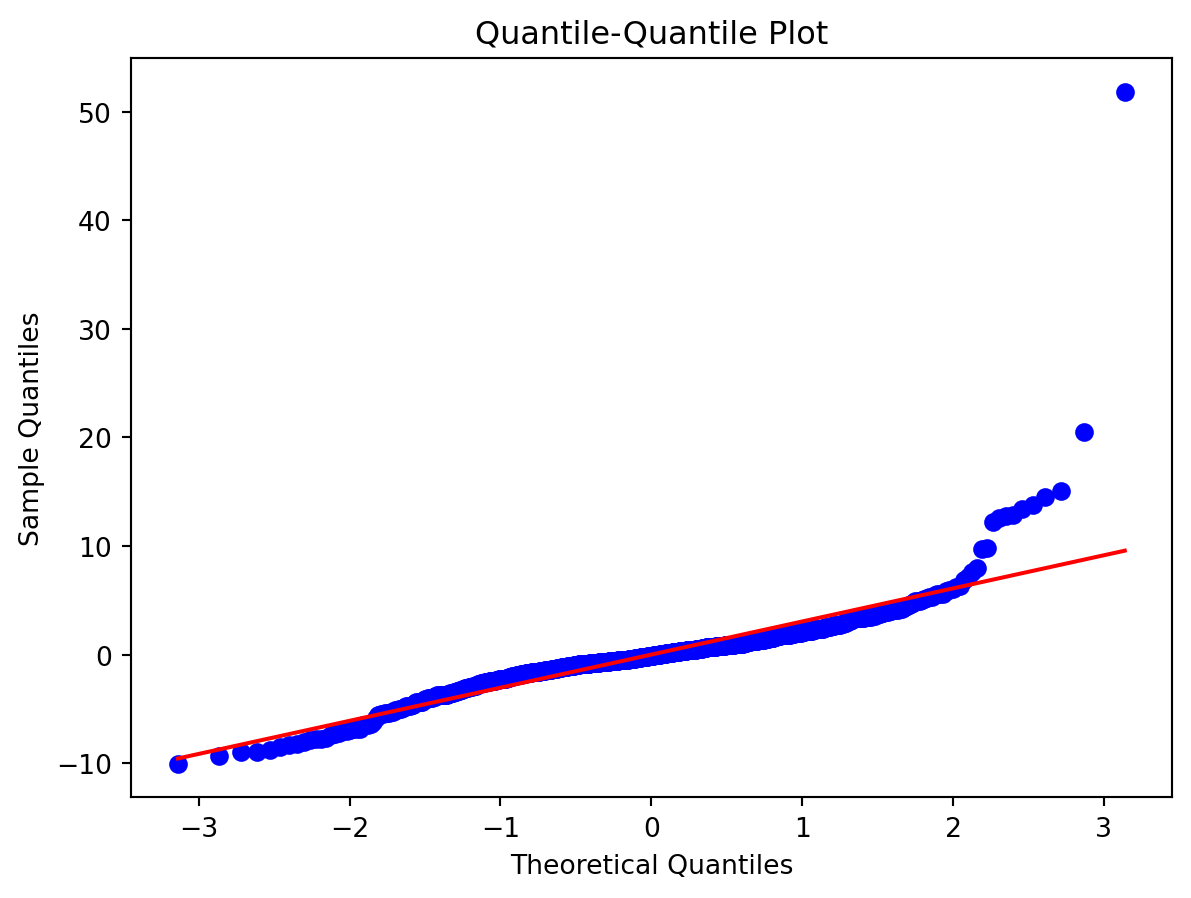
Normality of Residuals:
Check for …
- Are residuals normally distributed?
Leverage
Scale-Location plot
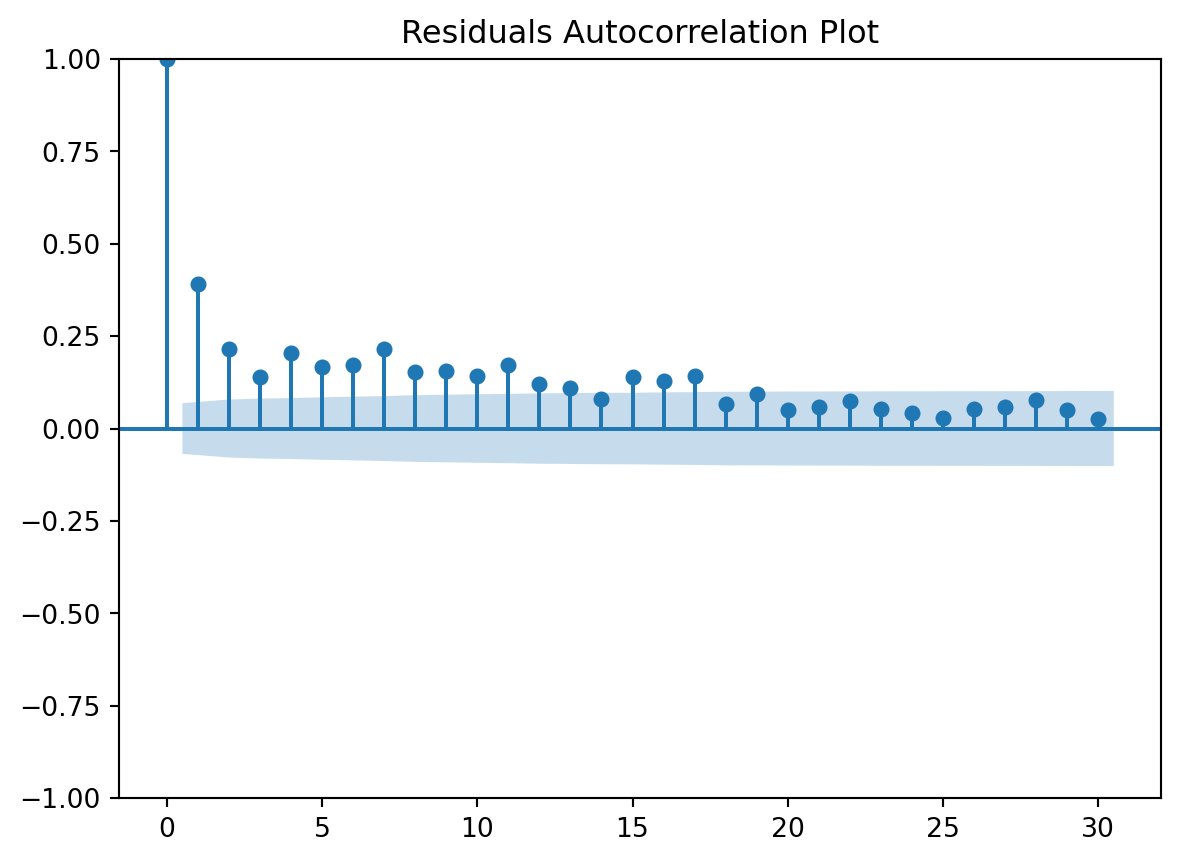
Residuals Autocorrelation Plot
Residuals vs Time
TODOs
Substantial improvement here, we still have some items in the to-do list and given these results, I would add a coulpe more:
Polynomials but using statsmodels …
                            OLS Regression Results
==============================================================================
Dep. Variable:                     wd   R-squared:                       0.848
Model:                            OLS   Adj. R-squared:                  0.847
Method:                 Least Squares   F-statistic:                     707.4
Date:                Sun, 12 Apr 2026   Prob (F-statistic):               0.00
Time:                        13:37:28   Log-Likelihood:                -3861.4
No. Observations:                1402   AIC:                             7747.
Df Residuals:                    1390   BIC:                             7810.
Df Model:                          11
Covariance Type:            nonrobust
=======================================================================================
                          coef    std err          t      P>|t|      [0.025      0.975]
---------------------------------------------------------------------------------------
Intercept              27.2336      2.654     10.261      0.000      22.027      32.440
tt_tu_mean             -1.9909      0.083    -24.046      0.000      -2.153      -1.828
I(tt_tu_mean ** 2)      0.0937      0.008     11.849      0.000       0.078       0.109
I(tt_tu_mean ** 3)     -0.0013      0.001     -1.291      0.197      -0.003       0.001
I(tt_tu_mean ** 4)  -7.429e-05   8.62e-05     -0.862      0.389      -0.000    9.47e-05
I(tt_tu_mean ** 5)   2.696e-06   2.11e-06      1.278      0.201   -1.44e-06    6.83e-06
rf_tu_mean              0.0370      0.033      1.116      0.265      -0.028       0.102
rf_tu_min              -0.0328      0.017     -1.939      0.053      -0.066       0.000
rf_tu_max              -0.0469      0.039     -1.199      0.231      -0.124       0.030
tt_tu_mean.shift(1)    -0.2229      0.073     -3.066      0.002      -0.366      -0.080
tt_tu_mean.shift(2)     0.0442      0.071      0.620      0.535      -0.096       0.184
tt_tu_mean.shift(3)    -0.0663      0.049     -1.367      0.172      -0.161       0.029
==============================================================================
Omnibus:                     1359.610   Durbin-Watson:                   0.837
Prob(Omnibus):                  0.000   Jarque-Bera (JB):           111116.297
Skew:                           4.328   Prob(JB):                         0.00
Kurtosis:                      45.746   Cond. No.                     4.65e+07
==============================================================================

Notes:
[1] Standard Errors assume that the covariance matrix of the errors is correctly specified.
[2] The condition number is large, 4.65e+07. This might indicate that there are
strong multicollinearity or other numerical problems.
Model Cards provide a framework for transparent, responsible reporting.
Use the vetiver `.qmd` Quarto template as a place to start,
with vetiver.model_card()
Writing pin:
Name: 'waermestrom'
Version: 20260412T133728Z-089b0<vetiver.vetiver_model.VetiverModel at 0x7ff318feb640>here’s also the polynomial model, but using scikit-learn
0.8477166938392322